Is GEO the New SEO in Marketing? 2026 Edition
This article discusses how Search Engine Optimization (SEO), although still necessary in the marketing world, is becoming a less powerful tool. Here, we talk about the newest form of marketing strategy, Generative Engine Optimization (GEO). This article covers what GEO is, how to implement it, and why you should consider adding GEO into your SEO strategy. Don’t worry… We’re not getting rid of SEO quite yet.

As we are entering 2026, it’s more prevalent than ever that AI is taking over and affecting our marketing strategies. Most marketing professionals today are experienced in using Search Engine Optimization (SEO) in their strategies and tactics, but are now needing to focus on Generative Engine Optimization (GEO) in addition to SEO. GEO is NOT a replacement for SEO. In fact, most GEO tactics are rooted from SEO, and it’s important to remember that both are important. It’s hard to say if one is more important than the other, but I believe both play a crucial role in how your company markets their products.
What is Search Engine Optimization in Marketing?
Search Engine Optimization (SEO) is the process of improving a website’s content, structure, and authority to naturally, or organically, rank higher in search engine results. This means that people or companies will implement SEO based strategies in hopes of ranking higher in search, so that when users search (on a search engine such as Google) a particular question or product, your company, website, or product appears high in search results (making it now well optimized for search).
What is Generative Engine Optimization in Marketing?
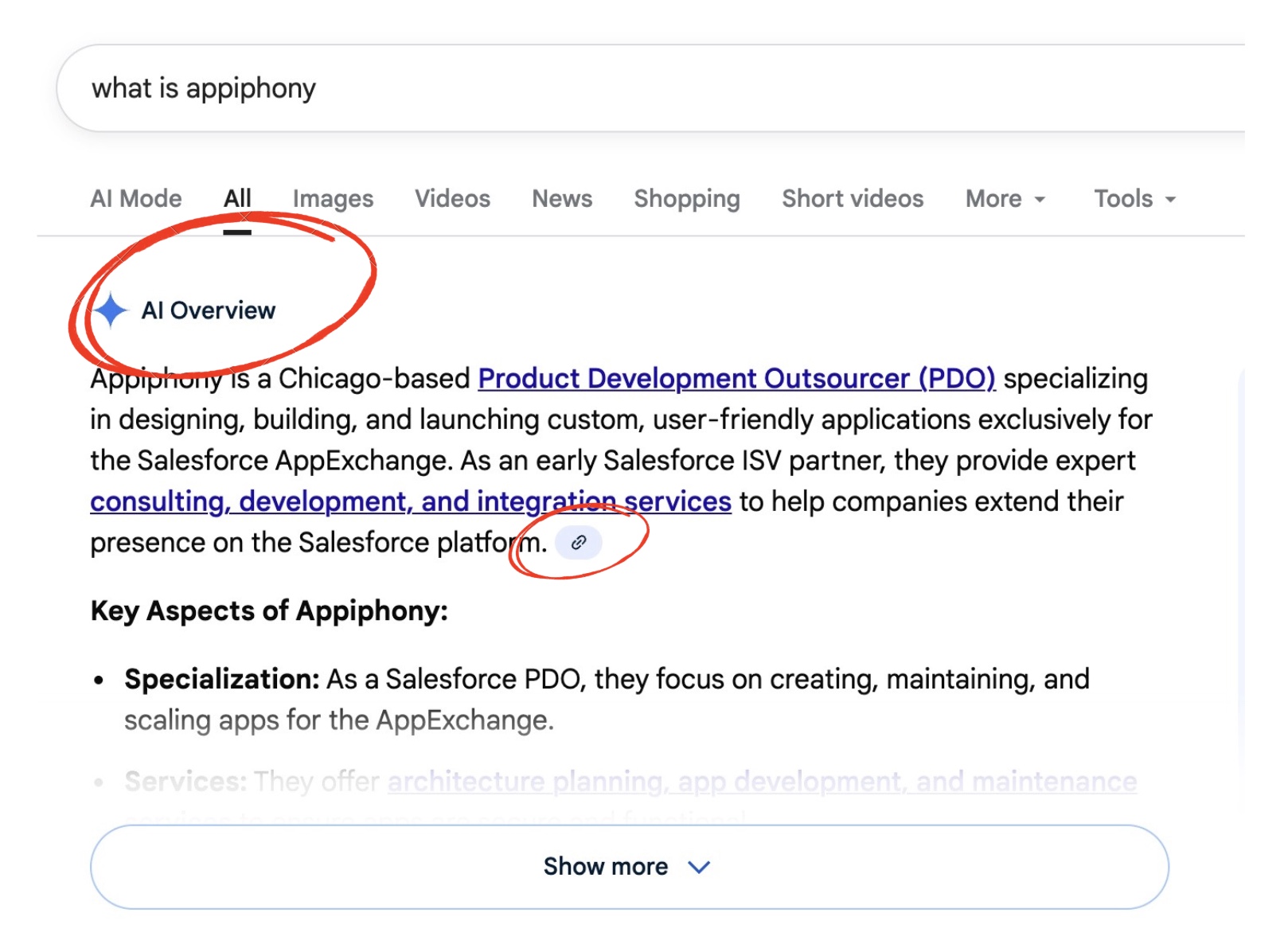
Generative Engine Optimization (GEO) is a strategy similar to SEO, but instead focuses on optimizing content to be cited, sourced, summarized or prioritized by AI (LLMS-Large Language Models). In the image to the right, you can see I googled a question, “what is appiphony”. I work for Appiphony as a Product Marketer, and chose this question to challenge our own GEO strategy. As you can see, I naturally received an AI Overview response. The circled link component below is where you want to be being sourced or cited from. When I click the link, I am brought to the source, which is Appiphony’s home page where we explain what we, as a company, are. Ultimately, the result of being cited in those links is the goal. Users clicking those links is what drives clicks, impressions, engagement, and views on our site which leads to higher natural ranking and further citations from LLMs. As far as I know (and I could very well be wrong), being sourced by LLMs does NOT contribute to any of the engagement metrics I previously mentioned. However, being sourced here allows users to view your site, or be told about your company or product and then open a new tab/start a new search, and look directly for whatever it is YOU offer. (This is good, this is what we want!)
How do I get my website to be sourced by LLMs and AI in 2026?
Notice the heading you just read, “How do I get my website to be sourced by LLMs and AI in 2026?”. If basing my strategy off SEO basics, I probably would’ve done something more like this; “Website Sourced by LLMs 2026”, or something along those lines. Maybe you didn’t notice the difference immediately, but optimizing for LLMs includes more question based content and prompts instead of just keywords, because that’s what users are searching in both search engines like Google and in LLMs such as ChatGPT. Although you should still aim to use keywords in your headers, we’re adjusting our practice to input these keywords into question based prompts instead.
For example, say you sell water bottles that do not leak. Based on SEO, maybe your optimized header or title could’ve been “Best no leak water bottle” because that’s how people were searching. But now, you should consider implementing headers or titles that align closer to user search queries, such as “What is the best leak proof water bottle?”. A question that comes up a lot in my professional setting, is ‘should we not use SEO strategy at all anymore?” and to be truthful, I don’t know. I find myself naturally catering to a GEO strategy before SEO, but I can’t be sure if one should be prioritized over the other.
LLMs do not like keyword stuffing (shoving a bunch of keywords into your blog post, page content, or headers/titles). They also are not fans of boilerplate content, meaning any content that duplicated from your site or others. That might sound like an obvious one, but I know I find myself in situations where content from one post might be relevant in another one, so copy and paste feels natural. It isn’t plagiarizing if it’s my own content, right? Try to avoid any copy and pasting.
Oddly enough, Large Language Models do not like when your content is AI generated. The base of everything I’m discussing is to be authentic, keep your content real, true, authentic, and authoritative. Site your sources, talk about what you know, and keep it real.
How do I adopt GEO into my content creation strategies?
You may need to shift your focus across more platforms, enabling more content and media styles if you’re not doing already. Having more forms of media and content across varying platforms raises your brand identity and authority (makes it more authentic). This table below shows where people may be searching for specific content. For example, if I’m selling my leak proof water bottles, like the example from above, maybe I’m creating comparison content such as “What are the three best leak proof water bottles right now?” and putting that on my site and Youtube, in hopes of being sourced by an LLM.
| Searcher Intent | Where they are Searching |
| Fix a Problem | Google, Youtube, LLMs |
| Vent Frustration | Reddit, Forums |
| Compare Tools | Google, Youtube, LLMs |
| Learn How it Works | Websites, LLMs |
| Evaluate Solutions | Product Sites, LLMs |
How do I format my content to be well optimized in 2025?
With implementing GEO, you may need to change your layout and formatting techniques. It’s important to keep your formatting specific, clear, and specifically addressing the users real intent (the goal they want to achieve by searching a specific prompt). An example would be:
“our product is a comprehensive, seamless solution” This is an SEO based, keyword stuffed sentence….
“If you are having *Problem*, *Product* is a simple solution” This is a GEO driven, authentic and relevant statement for your audience!
Additionally, notice how the beginning of this content explains in short summary what the article is about: “This article discusses how Search Engine Optimization (SEO)….” In my research, I’ve found that LLMs read (maybe scan or crawl is the better wording here), your articles, posts, blogs, etc, in search of finding a summary that explains exactly what your content is about. I find myself taking this tactic from my professional life into my personal blog writing. As with any habit, the more you do it the more natural it becomes. If you’re worried about implementing GEO and keeping strong within these habits, trust that it becomes easier the more you do it.
GEO vs SEO Helpful Content and Videos
Below, I’ve included some content that I’ve found helpful over the past few months. I hope you check them out, and keep practicing your SEO and GEO strategies.
Thanks for taking the time to check out my blog! My biggest piece of advice for anyone who is in the digital marketing world (looking for a job, wanting to get better at your job, practicing for fun), is to build your own website. What you’re on right now, samstrasler.com , is where I practice my SEO and GEO basics, and share what I love with coworkers, friends, peers, or anyone who stumbles upon it. Feel free to check out some of my other blogs and content, and I encourage you to create your own site (or message me on LinkedIn and I will help you in any way I can). Thanks!